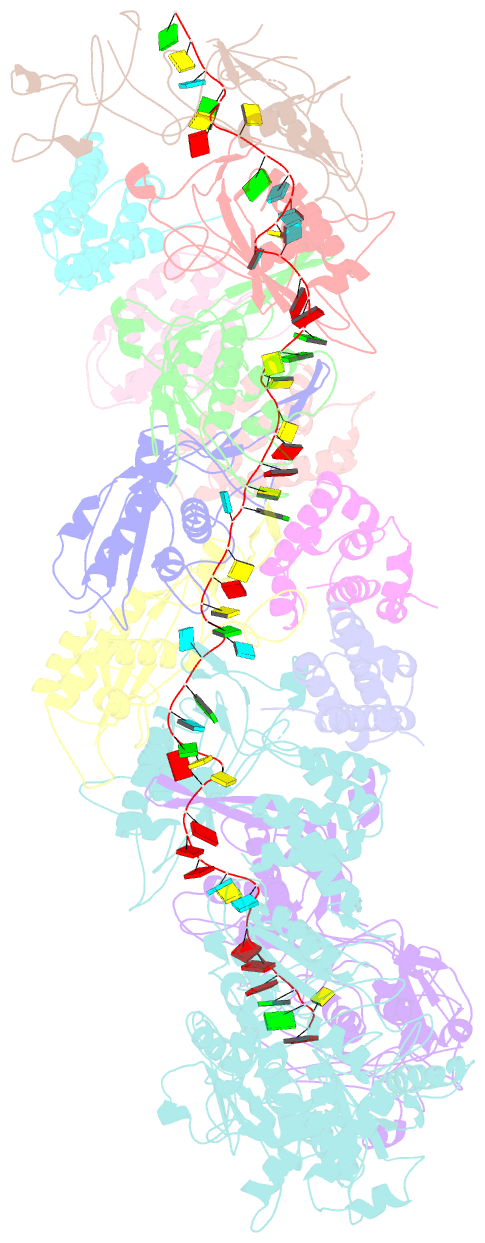
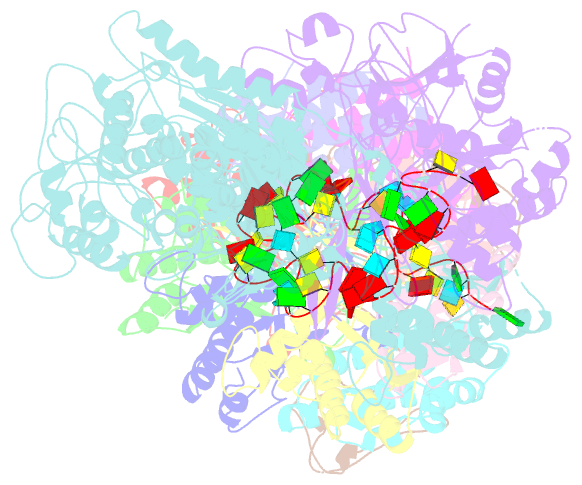
Summary information and primary citation
- PDB-id
-
8wfx;
DSSR-derived features in text and
JSON formats; DNAproDB
- Class
- RNA binding protein-RNA
- Method
- cryo-EM (3.73 Å)
- Summary
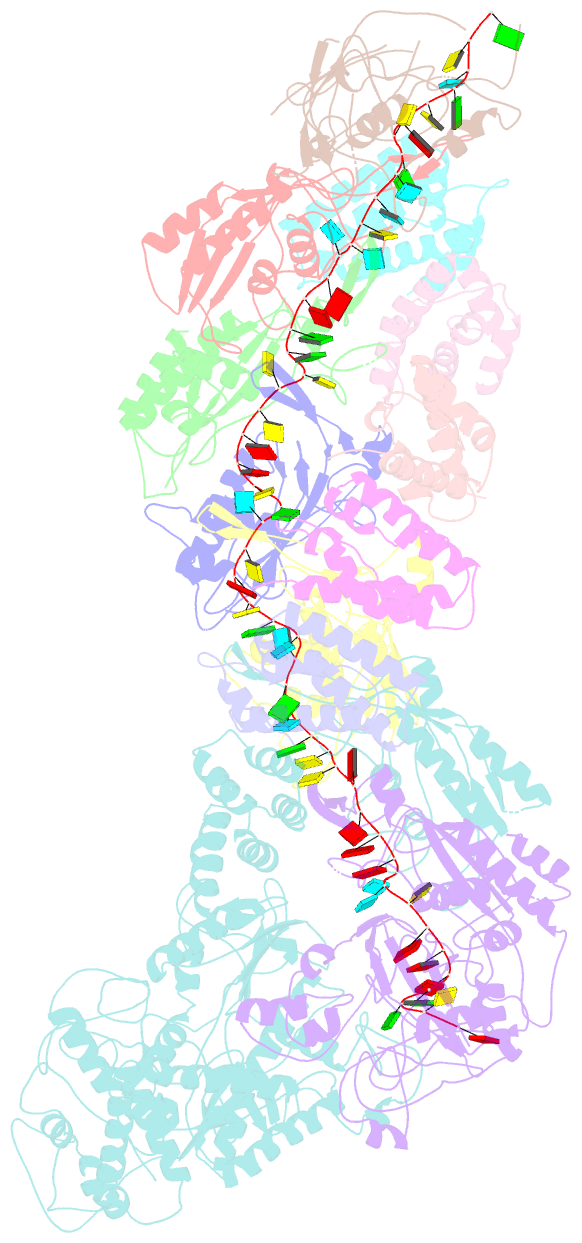
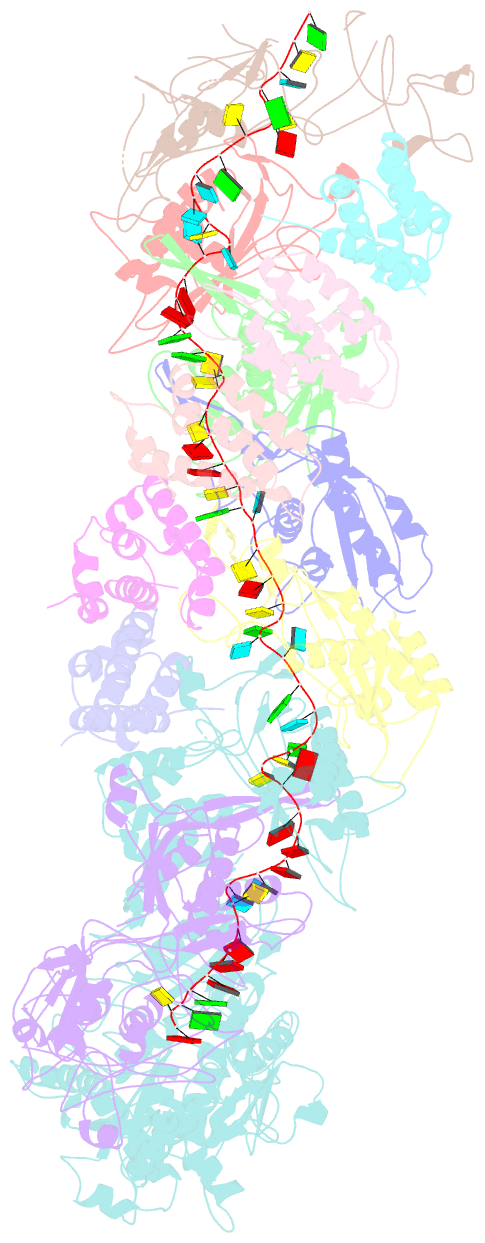
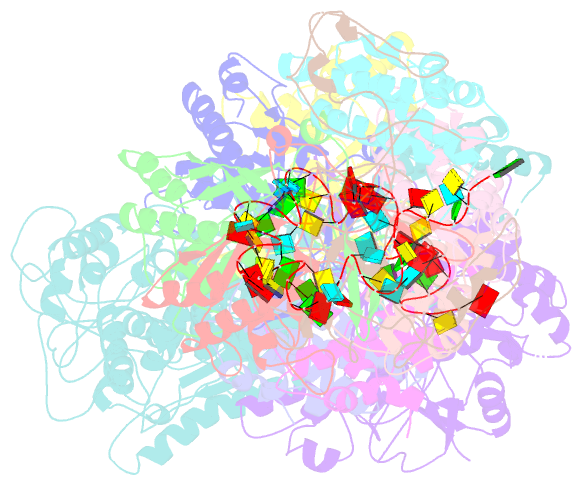
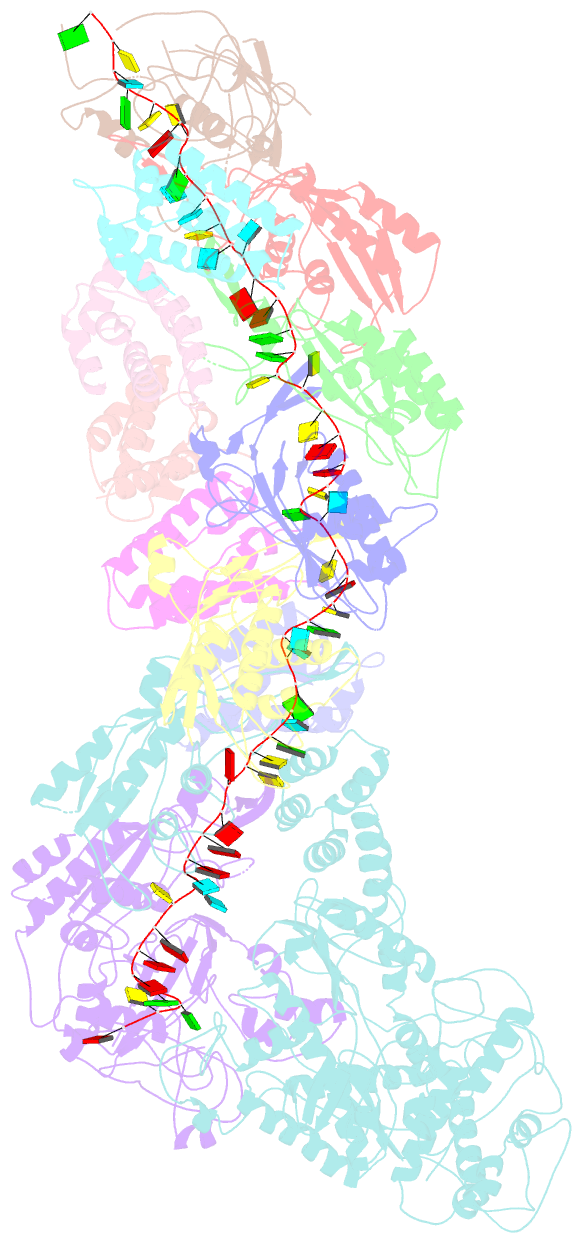
- cryo-EM structure of crispr-csm effector complex from
mycobacterium canettii
- Reference
-
Zhang H, Shi M, Ma X, Liu M, Wang N, Lu Q, Li Z, Zhao Y,
Zhao H, Chen H, Zhang H, Jiang T, Ouyang S, Huo Y, Bi L
(2024): "Type-III-A
structure of mycobacteria CRISPR-Csm complexes involving
atypical crRNAs." Int.J.Biol.Macromol.,
260, 129331. doi: 10.1016/j.ijbiomac.2024.129331.
- Abstract
- Tuberculosis (TB), a leading cause of mortality
globally, is a chronic infectious disease caused by
Mycobacterium tuberculosis that primarily infiltrates the
lung. The mature crRNAs in M. tuberculosis transcribed from
the Clustered Regularly Interspaced Short Palindromic
Repeats (CRISPR) locus exhibit an atypical structure
featured with 5' and 3' repeat tags at both ends of the
intact crRNA, in contrast to typical Type-III-A crRNAs that
possess 5' repeat tags and partial crRNA sequences.
However, this structural peculiarity particularly
concerning the specific binding characteristics of the 3'
repeat end within the mature crRNA within the Csm complex,
has not been comprehensively elucidated. Here, our
Mycobacteria CRISPR-Csm complexes structure represents the
largest Csm complex reported to date. It incorporates an
atypical Type-III-A CRISPR RNA (crRNA) (46 nt) with 5'
8-nt and 3' 4-nt repeat sequences in the stoichiometry of
Mycobacteria
Csm1<sub>1</sub>2<sub>5</sub>3<sub>6</sub>4<sub>1</sub>5<sub>1.</sub>
The PAM-independent single-stranded RNAs (ssRNAs) are the
most suitable substrate for the Csm complex. The 3'-repeat
end trimming of mature crRNA was not necessary for its
cleavage activity in Type-III-A Csm complex. Our work
broadens our understanding of the Type-III-A Csm complex
and identifies another mature crRNA processing mechanism in
the Type-III-A CRISPR-Cas system based on structural
biology.