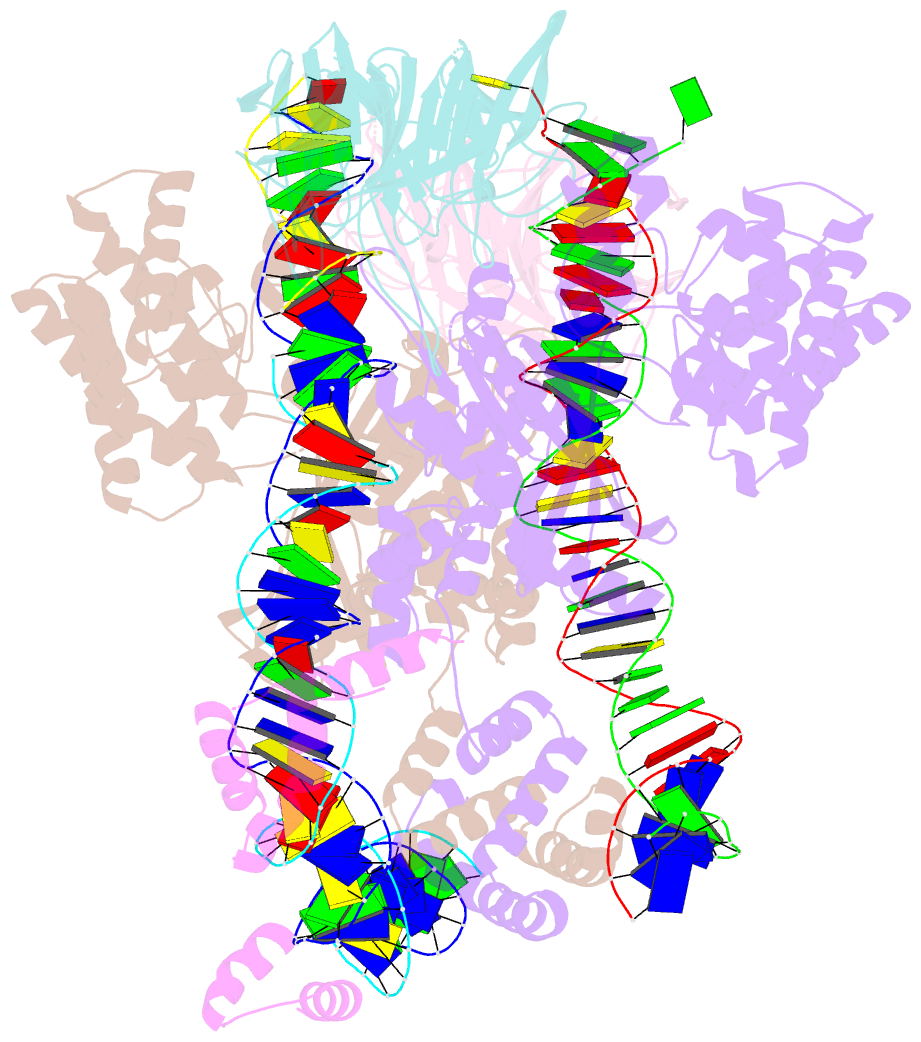
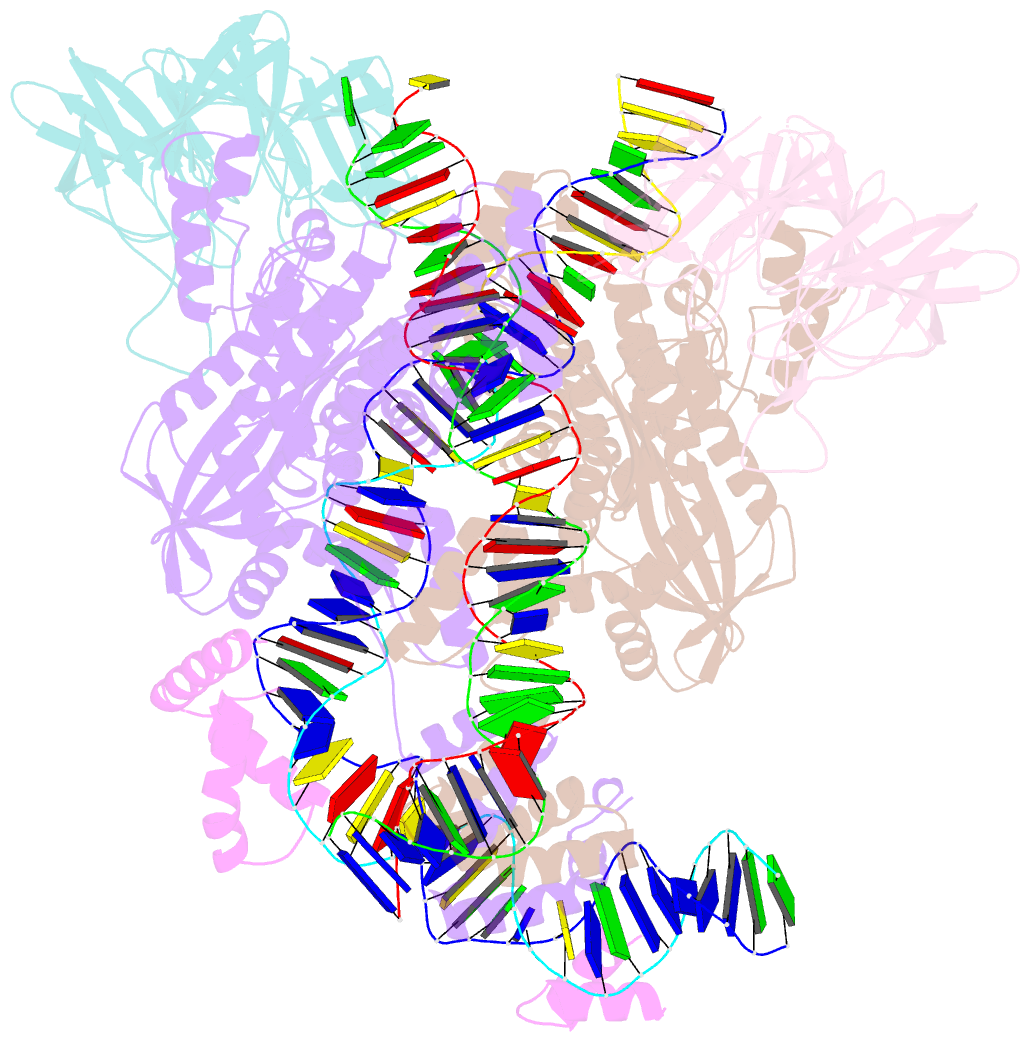
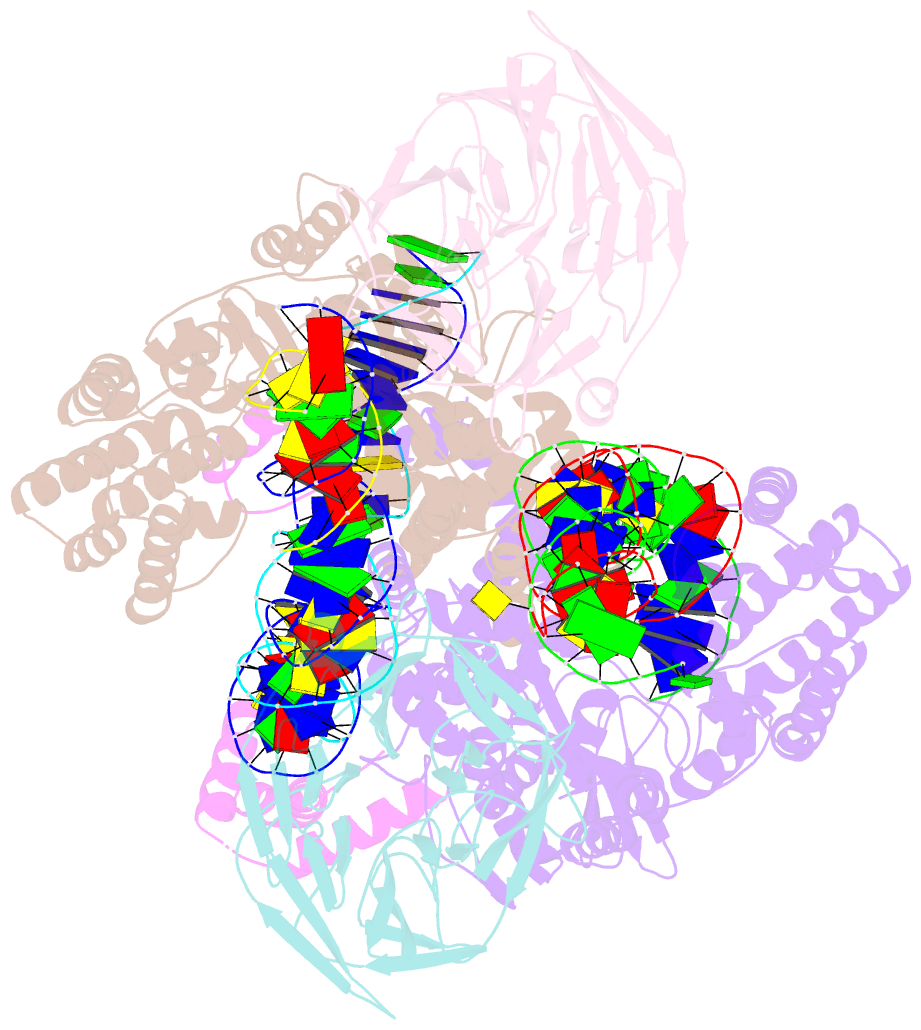
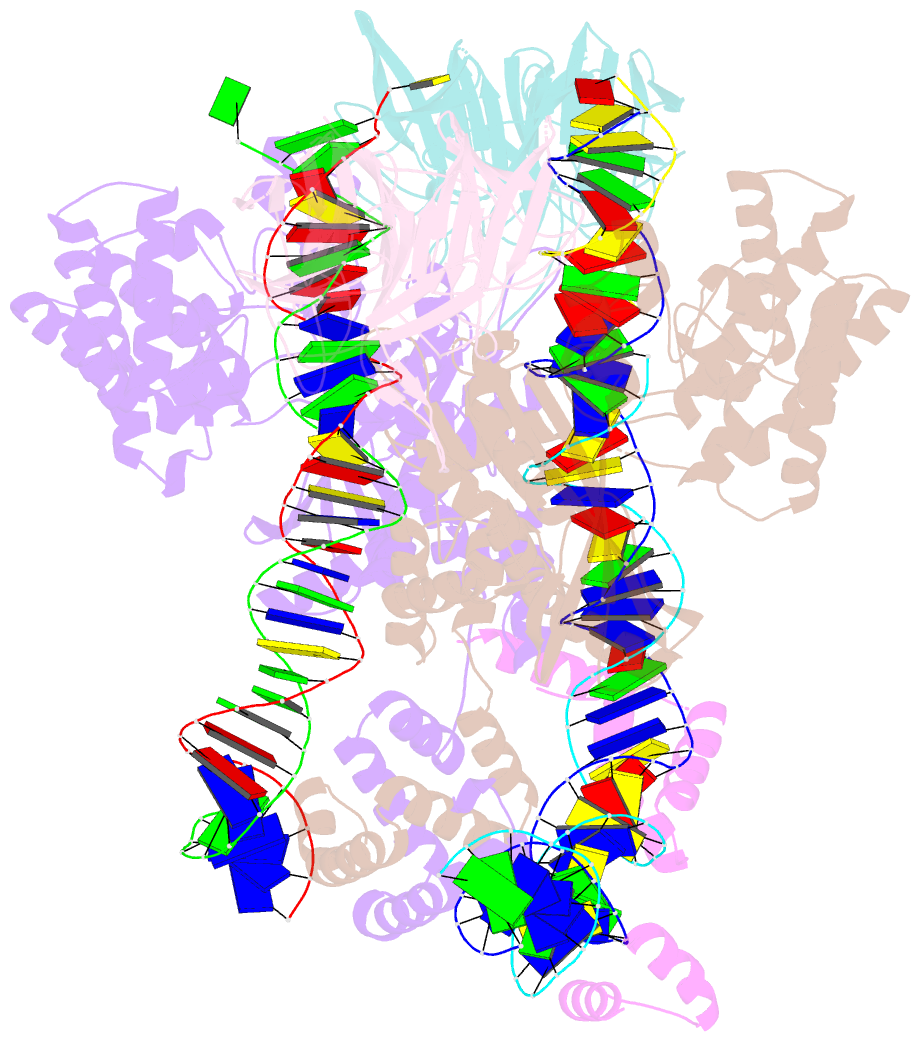
Summary information and primary citation
- PDB-id
-
6cik;
DSSR-derived features in text and
JSON formats; DNAproDB
- Class
- recombination-DNA
- Method
- X-ray (3.15 Å)
- Summary
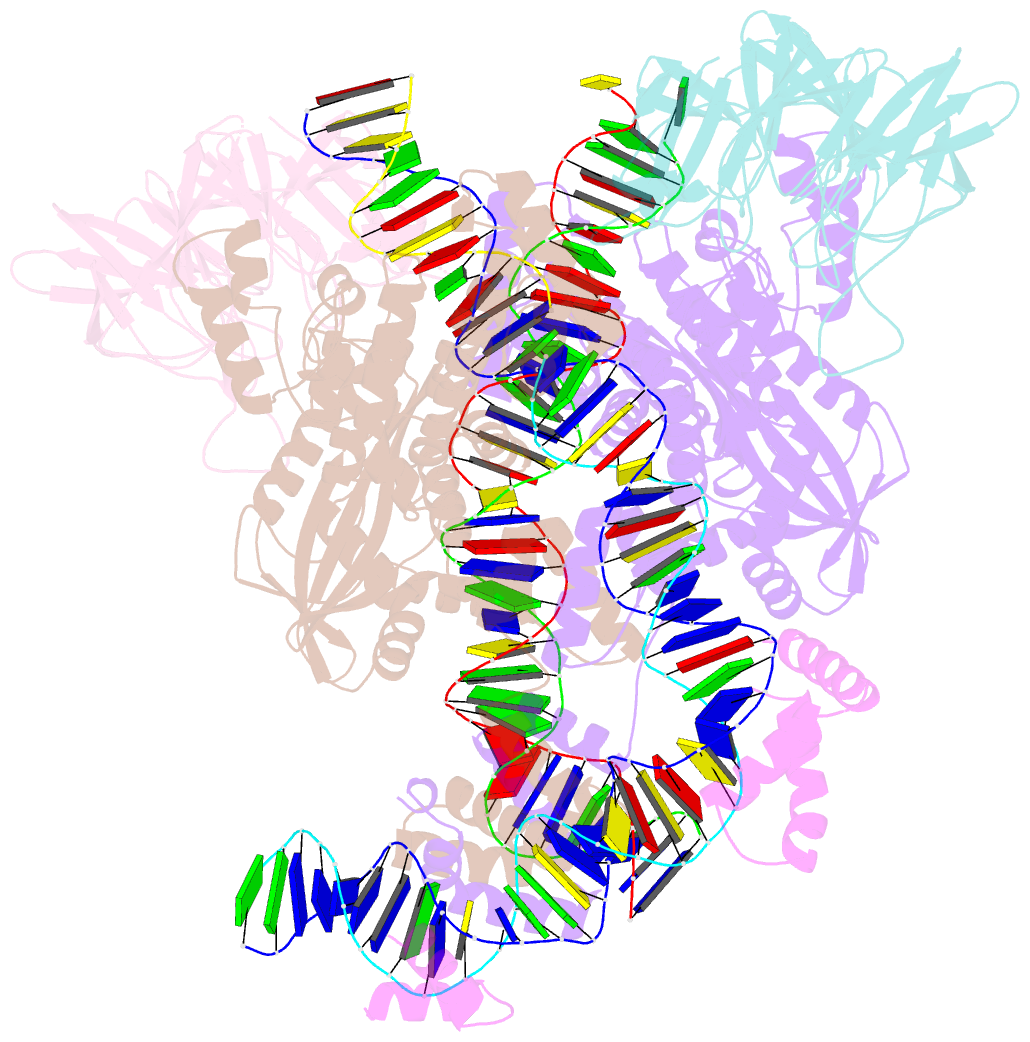
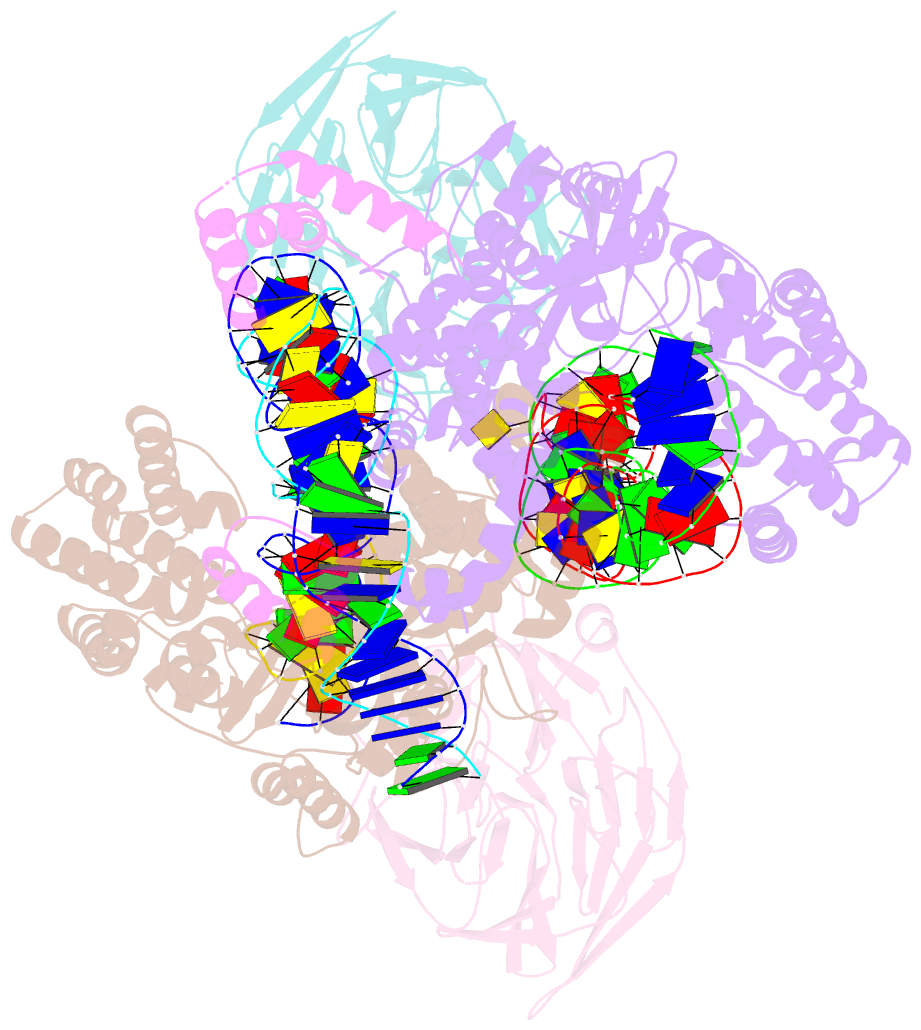
- Pre-reaction complex, rag1(e962q)-2-intact-nicked
12-23rss complex in mn2+
- Reference
-
Kim MS, Chuenchor W, Chen X, Cui Y, Zhang X, Zhou ZH,
Gellert M, Yang W (2018): "Cracking
the DNA Code for V(D)J Recombination." Mol.
Cell, 70, 358-370.e4. doi: 10.1016/j.molcel.2018.03.008.
- Abstract
- To initiate V(D)J recombination for generating the
adaptive immune response of vertebrates, RAG1/2 recombinase
cleaves DNA at a pair of recombination signal sequences,
the 12- and 23-RSS. We have determined crystal and cryo-EM
structures of RAG1/2 with DNA in the pre-reaction and
hairpin-forming complexes up to 2.75 Å resolution.
Both protein and DNA exhibit structural plasticity and
undergo dramatic conformational changes. Coding-flank DNAs
extensively rotate, shift, and deform for nicking and
hairpin formation. Two intertwined RAG1 subunits crisscross
four times between the asymmetric pair of severely bent
12/23-RSS DNAs. Location-sensitive bending of 60° and 150°
in 12- and 23-RSS spacers, respectively, must occur for
RAG1/2 to capture the nonamers and pair the heptamers for
symmetric double-strand breakage. DNA pairing is thus
sequence-context dependent and structure specific, which
partly explains the "beyond 12/23" restriction. Finally,
catalysis in crystallo reveals the process of DNA hairpin
formation and its stabilization by interleaved base
stacking.