Summary information and primary citation
- PDB-id
-
3oyd;
DSSR-derived features in text and
JSON formats; DNAproDB
- Class
- recombination,viral protein-DNA
- Method
- X-ray (2.54 Å)
- Summary
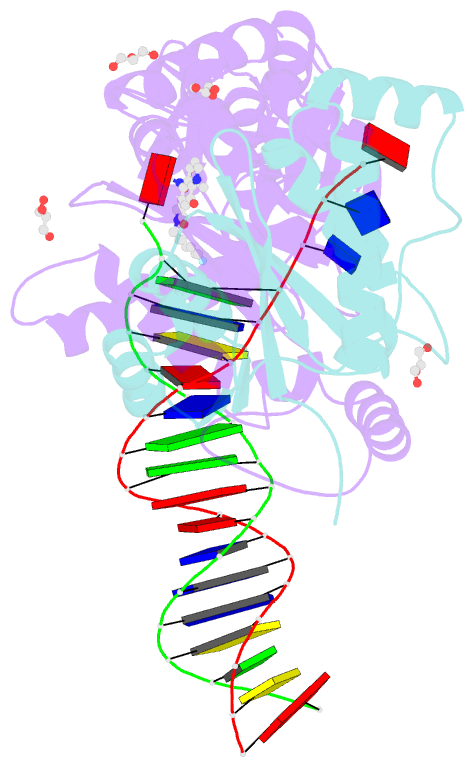
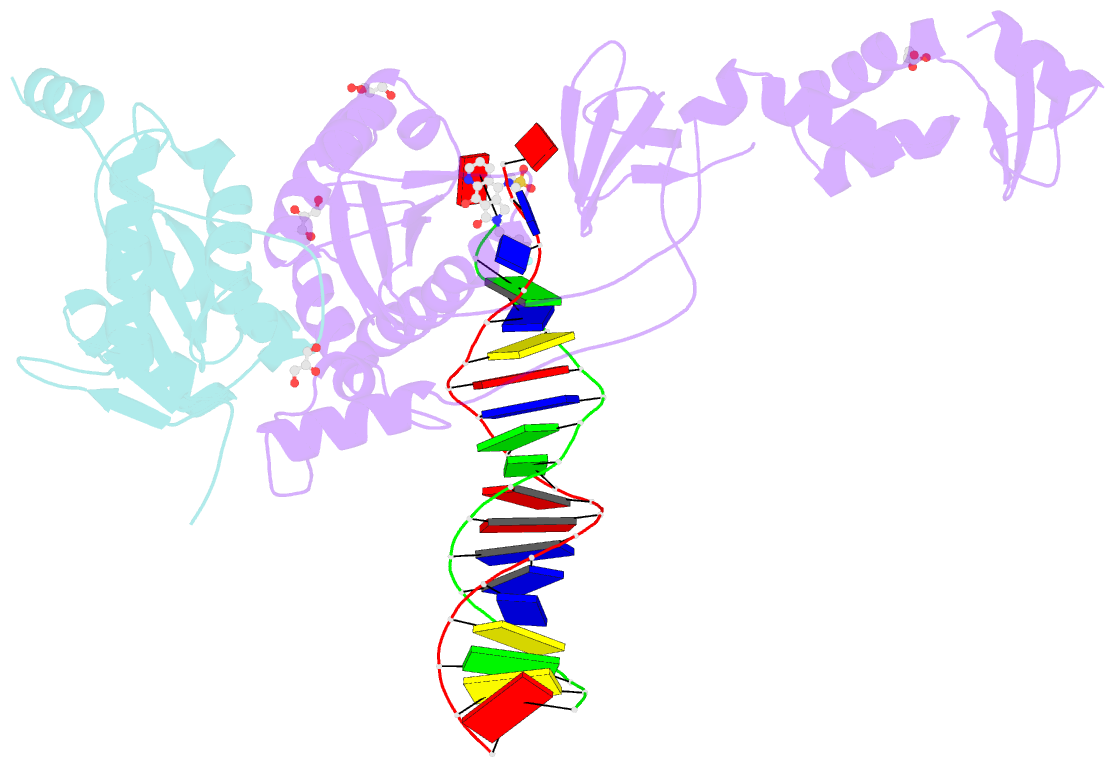
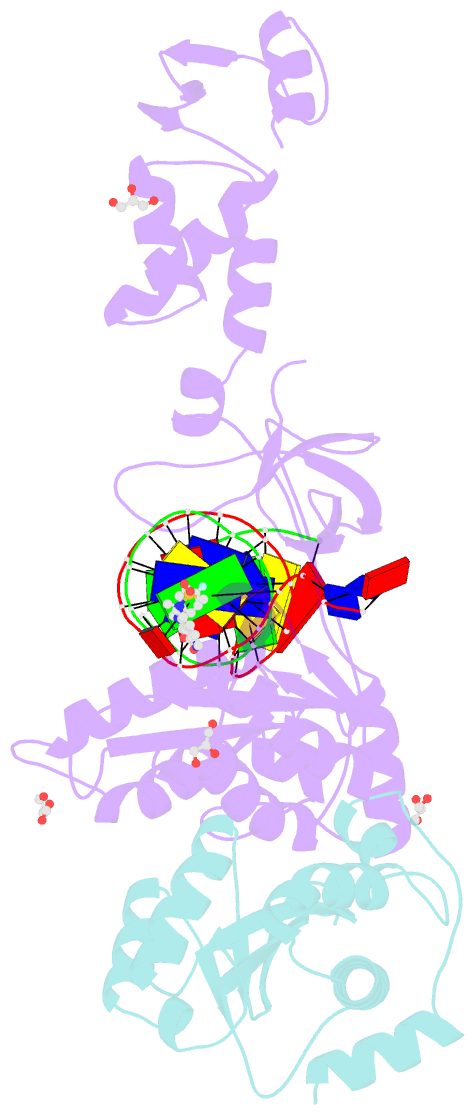
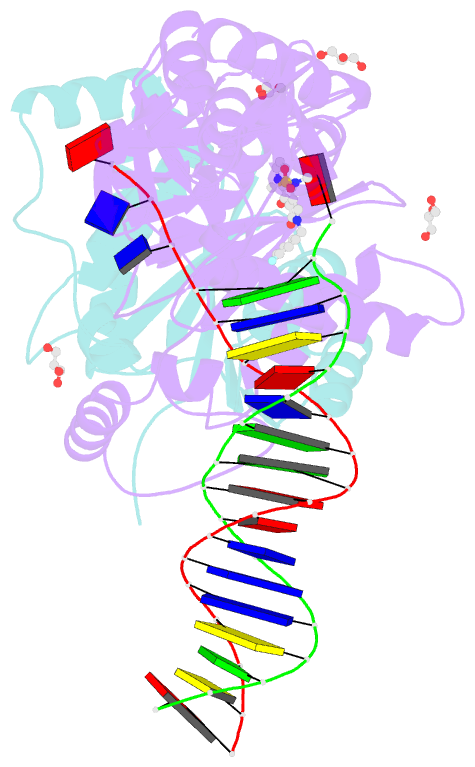
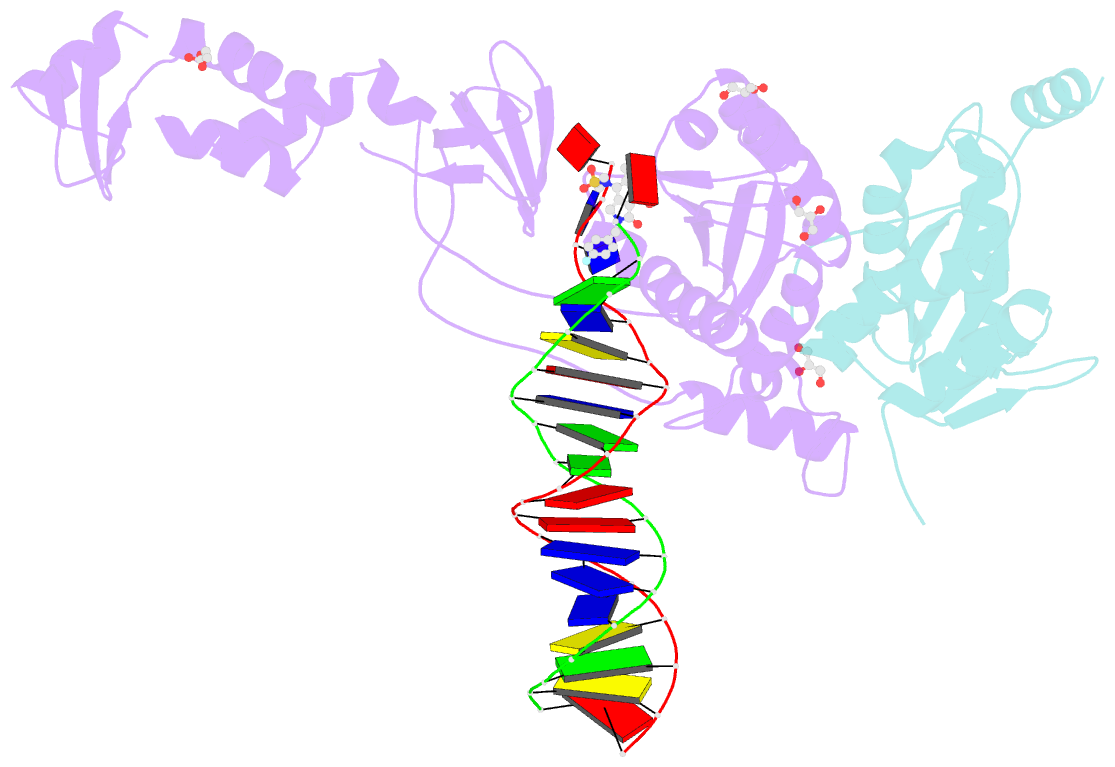
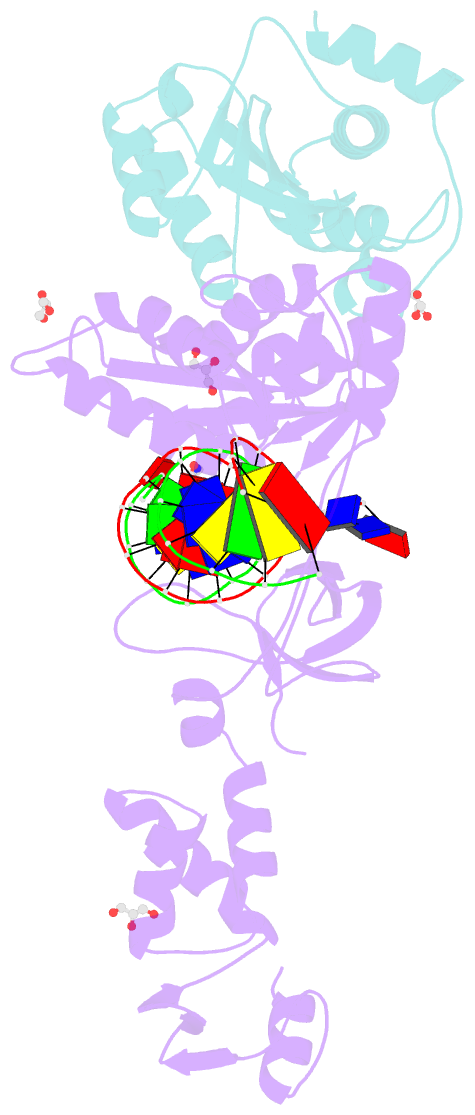
- Crystal structure of the prototype foamy virus (pfv)
intasome in complex with magnesium and the insti
gs9160
- Reference
-
Hare S, Vos AM, Clayton RF, Thuring JW, Cummings MD,
Cherepanov P (2010): "Molecular
mechanisms of retroviral integrase inhibition and the
evolution of viral resistance."
Proc.Natl.Acad.Sci.USA, 107,
20057-20062. doi: 10.1073/pnas.1010246107.
- Abstract
- The development of HIV integrase (IN) strand transfer
inhibitors (INSTIs) and our understanding of viral
resistance to these molecules have been hampered by a
paucity of available structural data. We recently reported
cocrystal structures of the prototype foamy virus (PFV)
intasome with raltegravir and elvitegravir, establishing
the general INSTI binding mode. We now present an expanded
set of cocrystal structures containing PFV intasomes
complexed with first- and second-generation INSTIs at
resolutions of up to 2.5 Å. Importantly, the improved
resolution allowed us to refine the complete coordination
spheres of the catalytic metal cations within the
INSTI-bound intasome active site. We show that like the
Q148H/G140S and N155H HIV-1 IN variants, the analogous
S217H and N224H PFV INs display reduced sensitivity to
raltegravir in vitro. Crystal structures of the mutant PFV
intasomes in INSTI-free and -bound forms revealed that the
amino acid substitutions necessitate considerable
conformational rearrangements within the IN active site to
accommodate an INSTI, thus explaining their adverse effects
on raltegravir antiviral activity. Furthermore, our
structures predict physical proximity and an interaction
between HIV-1 IN mutant residues His148 and Ser/Ala140,
rationalizing the coevolution of Q148H and G140S/A
mutations in drug-resistant viral strains.